Are We All Connected to the Universe?
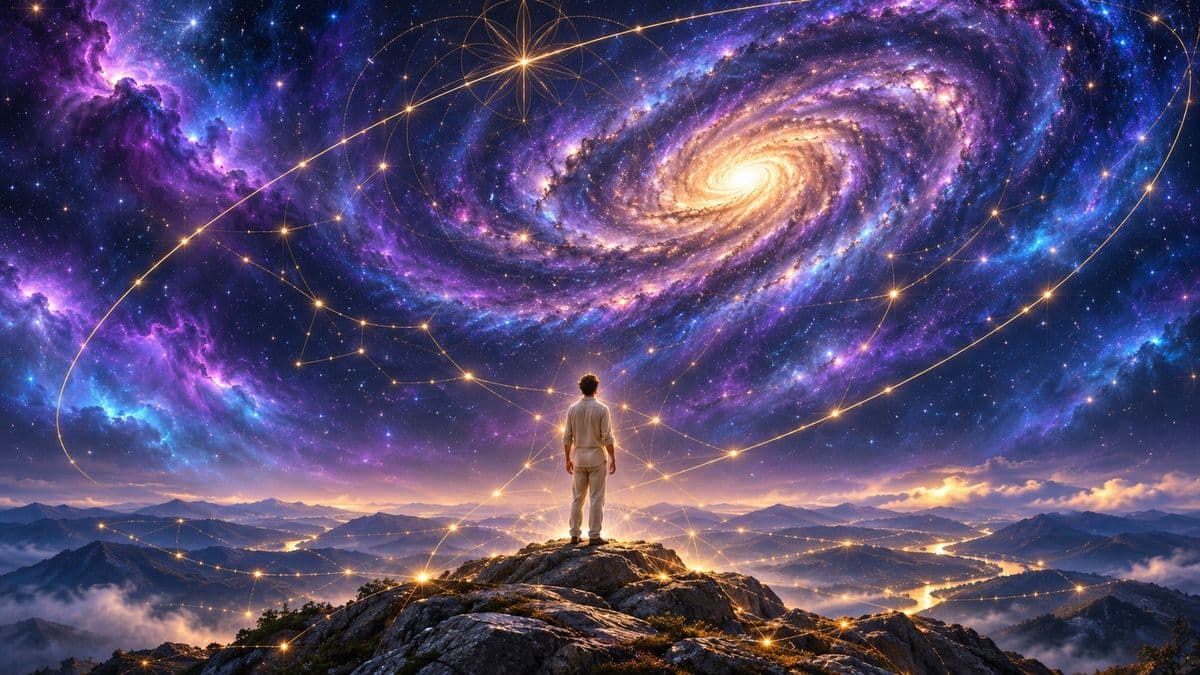
The question of our connection to the universe is one of the deepest and oldest philosophical and spiritual questions.
The question of our connection to the universe is one of the deepest and oldest philosophical and spiritual questions. From ancient civilizations to modern science, people have searched for answers to the same fundamental questions: Who are we? Where do we come from? And what role do we play in the greater order of the universe?
Today, both spiritual teachings and scientific theories invite us to look beyond the idea that we are completely separate beings existing in an isolated physical world. Instead, we can explore the possibility that we are part of a much larger and deeply interconnected system.
But how exactly are we connected to the universe? Is this simply a metaphor for spiritual unity, or is there also a physical reality behind it? In this article, we explore universal connection from spiritual, scientific, and everyday perspectives.
The Spiritual Perspective: The Universe as One
Many spiritual traditions, including Hinduism, Buddhism, Taoism, and Indigenous traditions, describe existence as fundamentally interconnected. Rather than viewing the universe as a collection of separate parts, they see it as a whole in which everything influences and depends on everything else.
1. The Universe as an Energy System
In many spiritual traditions, everything from human beings to stars is described in terms of energy. The body, thoughts, emotions, and the natural world are understood as different expressions of a larger energetic reality.
Concepts such as Prana in Indian traditions describe a vital energy associated with life and consciousness.
Think of the feeling that can arise when you watch a sunset, stand beneath a night sky, or sit quietly in nature. For a moment, the boundary between “you” and the world may seem less important. Instead of observing nature from the outside, you feel as though you belong to it.
Spiritual traditions interpret moments like these as reminders of a connection that was never truly lost.
2. Spiritual Interconnection
Buddhism emphasizes interdependence. Nothing exists completely independently because every phenomenon arises through countless conditions and relationships.
Hindu philosophy contains the concept of Brahman, the ultimate reality underlying existence. In several Hindu traditions, Atman, the deepest self, is understood in relation to this universal reality.
Taoism emphasizes harmony between human beings, nature, and the Tao, the underlying way through which existence unfolds.
Although these traditions use different language, they share an important idea: separation may not be as absolute as it appears.
The Scientific Perspective: How Are We Physically Connected?
Science does not establish that all human minds or consciousness are connected through a universal spiritual field. What it does reveal, however, is something equally extraordinary: everything in the observable universe shares a physical history and exists within interconnected systems.
1. Quantum Physics and Interconnection
Quantum physics explores the behavior of matter and energy at extremely small scales. One of its most fascinating phenomena is quantum entanglement.
When quantum systems become entangled, measurements performed on them can display correlations even when the particles are separated by large distances. This phenomenon demonstrates that quantum systems can have relationships that do not resemble ordinary everyday interactions.
Quantum entanglement does not prove that human thoughts, emotions, or consciousness are telepathically connected across the universe. However, it challenges our intuitive idea that everything in nature must always behave as completely independent objects.
Modern physics also describes reality through quantum fields. In quantum field theory, particles can be understood as excitations of underlying fields that extend throughout space.
In that scientific sense, matter is not composed of completely isolated little objects floating independently through emptiness. Reality is far more interconnected and dynamic than it appears at first glance.
We Are Literally Made of Stars
Perhaps the most beautiful scientific connection between humans and the cosmos is not metaphorical at all.
Many of the elements found in the human body were formed through processes involving earlier generations of stars. Elements such as carbon, oxygen, nitrogen, and iron have a cosmic history that reaches far beyond Earth.
The material from which your body is built did not begin with you.
Before becoming part of your blood, bones, lungs, and cells, much of it belonged to a universe that had already existed for billions of years.
In that sense, we do not merely live inside the universe.
We are made from the universe itself.
The separation between “us” and “the cosmos” becomes much less obvious when we remember that the atoms composing our bodies are part of the same physical history as planets, oceans, and stars.
Biological Connection: We Are Part of a Living System
Our connection does not end with the stars. Every breath reminds us that we are inseparable from life on Earth.
Plants produce oxygen through photosynthesis, while humans and other organisms participate in the continuous exchange of oxygen, carbon dioxide, water, and nutrients through Earth's ecosystems.
The food you eat once belonged to another living system. The oxygen entering your lungs was released into the atmosphere through processes occurring elsewhere in nature. Your body also follows environmental rhythms, particularly the cycle of light and darkness that helps regulate the sleep-wake rhythm.
We often speak about “nature” as though it were something outside us.
But biologically, there is no absolute boundary.
We are participants in the ecosystem, not spectators standing beside it.
What Does It Mean to Feel Connected to the Universe?
Feeling connected to the universe can describe an experience in which the usual sense of separation between the self and the wider world becomes less dominant.
This can happen during meditation, contemplation, time in nature, deep emotional experiences, or moments of profound stillness.
You may suddenly stop experiencing yourself as an isolated individual struggling against the world and instead feel part of something larger.
Science can describe the physical processes occurring in the brain and body during such experiences. Spiritual traditions explore another dimension: what the experience means.
These perspectives do not have to cancel each other out.
One can describe mechanism.
The other can explore meaning.
Connection Begins When Separation Becomes Quieter
Most of everyday life reinforces separation. My responsibilities. My problems. My body. My future. My success. My fear.
The mind builds an identity around the word “mine.”
Meditation and conscious breathing can create a different experience. As mental activity becomes quieter and attention moves inward, the boundary between the observing self and the surrounding world may begin to feel less rigid.
At Oasis of Life, meditation, conscious breathing, visualization, and immersive experiences are brought together to support this movement from constant mental activity toward deeper awareness.
The purpose is not to convince you what the universe is.
It is to create the conditions in which you can experience your relationship with it differently.
Perhaps connection is not something you need to create.
Perhaps it is something you begin to notice when the noise of separation becomes quiet enough.
Look at the night sky and remember: the elements within your body belong to the same cosmic history as the stars above you.
Take a breath and remember: the air inside you was outside you only a moment ago.
The line between “you” and “the universe” has always been more fluid than it seems.
At Oasis of Life, the journey begins by becoming still enough to experience that connection for yourself.